Darren Soto


Add An Item To Darren Soto's Record
Darren Soto's Record on Bitcoin, Cryptocurrencies, and Blockchain
- 8/29/2021, 7:56:13 PM
Positive. +1
December 31, 2020 Washington, D.C. - Today, Congressman Tom Emmer (MN-06), Congressman Bill Foster (IL-11), Congressman David Schweikert (AZ-06), Congressman Darren Soto (FL-09), Congressman Warren Davidson (OH-08), Congresswoman Suzan K. DelBene (WA-01), Congressman Ted Budd (NC-13), Congress Woman Tulsi Gabbard (HI-02) and Senator Tom Cotton (AR) sent a letter to Treasury Secretary Steven Mnuchin to express concerns regarding a limited comment period to respond to a recently released rule making significant changes to the regulation of digital assets. The rule was announced on December 18, 2020, and comments must be received by January 4, 2021. The Financial Crimes Enforcement Network’s (FinCEN) rule would require certain members of the cryptocurrency industry to submit additional reports and keep records relating to customer identities if transactions are made above certain thresholds. The additional data collection also pertains to unhosted wallets, which do not require a financial institution to conduct transactions. “The blockchain industry and cryptocurrency innovations are constantly and rapidly evolving. Government frequently struggles to keep up. We owe it to this community to be fair, transparent, and open to stakeholder advice," said Emmer.
Reference LinkSubmitted By: Anonymous - 8/29/2021, 6:57:26 PM
Positive. +1
Joined bipartisan Blockchain Caucus co-chairs @RepTomEmmer, @RepBillFoster and @RepDavid in a letter to our House colleagues raising concerns about #cryptocurrency tax reforms in Bipartisan Senate Infrastructure bill.
Click for Tweet Screenshot In Case of Deletion or Edits
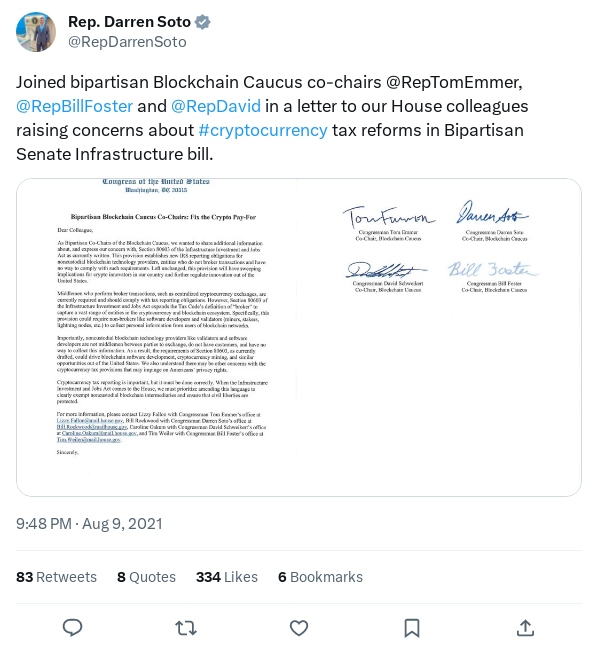 Reference LinkSubmitted By: Anonymous
 - 8/29/2021, 6:52:24 PM
Positive. +1
October 6, 2020 WASHINGTON, DC - Today, Congressmen David Schweikert (AZ-06) and Darren Soto (FL-09) introduced H.R. 8524, the Blockchain Records and Transaction Act, legislation to expand the utilization and definition of blockchain technology, and ensure all blockchain-secured records and smart contracts can be verified as legal e-signatures. The Blockchain Records and Transactions Act would: - Amend the definition of “electronic records” to include blockchains and records maintained on blockchains;. - Amend the definition of “electronic agent” to include smart contracts; - Define blockchain and smart contracts; and - Ensure states cannot avoid giving legal recognition to blockchain records through reverse pre-emption.
Reference LinkSubmitted By: Anonymous - 8/29/2021, 6:50:37 PM
Positive. +1
July 28, 2020 WASHINGTON, DC – Last week, Congressman David Schweikert (AZ-06) and Congressman Darren Soto’s (FL-09) bipartisan amendment to increase funding for the FDA to enhance the security and reliability of U.S. supply chains during the COVID-19 pandemic for food, pharmaceuticals, and other essential medical equipment and supplies through technologies such as blockchain passed the House of Representatives. This bipartisan amendment was included in H.R. 7608, the Department of State, Foreign Operations, and Related Programs Appropriations Act of 2021. "The need for secure food and drug supply chains is critical, particularly as our country continues to disperse resources to fight COVID-19 ,” said Rep. Schweikert. “I was pleased to see my bipartisan amendment pass to help ensure we are ready for the next steps in fighting this virus. By utilizing blockchain technology, we can enhance the reliability of our delivery services and ensure our food and medical supplies are properly disbursed." "Unfortunately, the coronavirus pandemic has inevitably shown us the importance of protecting Florida’s food supply and our precious crops,” said Rep. Soto. “Our amendment helps put safe, nutritious food on Americans’ tables and increases investments to enhance the security and reliability of our supply stockpiles though blockchain technology."
Reference LinkSubmitted By: Anonymous - 8/29/2021, 6:46:33 PM
Positive. +1
October 17, 2019 WASHINGTON, DC – Today, Co-Chairs of the Congressional Blockchain Caucus Congressman David Schweikert (AZ-06) and Congressman Darren Soto (FL-09) sent a letter to the United States Food and Drug Administration supporting the agency’s upcoming session on a blueprint for “A New Era of Smarter Food Safety” which will focus on maintaining food safety through technologies including blockchain. “Blockchain technology applications offer promising solutions to reduce food safety risks in our nation’s food supply. We applaud the efforts of the FDA’s blueprint and we’re pleased language for FDA food traceability measures were included in the FY 2020 House Appropriations report language.” wrote the Co-Chairs.
Reference LinkSubmitted By: Anonymous - 8/29/2021, 6:10:34 PM
Positive. +1
More than a dozen members of the House of Representatives sent a letter to Securities and Exchange Chairman Jay Clayton Friday urging his agency to tell investors, in plain English, how it plans to regulate cryptocurrency. “It is important that all policy makers work toward developing clearer guidelines between those digital tokens that are securities, and those that are not, through better articulation of SEC policy, and, ultimately, through formal guidance or legislation,” the letter said. The letter was an effort from both sides of the aisle, and was lead by Rep. Ted Budd, R-N.C., Reps. Emmer and Davidson, as well Darren Soto, D-Fla. In addition, David Schweikert, R-Ariz., Jeff Duncan, R- S.C., Alex Mooney, R- W.V., John Curtis, R-Utah, Ralph Norman, R- S.C., Andy Biggs, R-Ariz., Mark Meadows, R-N.C., Derek Kilmer, D-Wash., Greg Gianforte, R-Mont., and Sean Duffy, R-WI, were among the signatories.
Reference LinkSubmitted By: Anonymous - 8/29/2021, 4:16:56 PM
Positive. +1
Emmer Leads Bipartisan Blockchain Caucus Letter to the IRS Ahead of Tax Day Urging Virtual Currency Guidance: "Guidance is long overdue and essential to proper reporting of these emerging assets. The bipartisan support this letter has received should send a clear message to the IRS that clear guidelines for reporting virtual currency are necessary." Said Emmer, "My colleagues and I are optimistic that the IRS will issue the guidance needed for taxpayers struggling with these reporting requirements." Signers include Bill Foster (D-IL), David Schweikert (R-AZ), Darren Soto (D-FL), Patrick McHenry (R-NC), Jim McGovern (D-MA), French Hill (R-AR), Terri Sewell (D-AL), Warren Davidson (R-OH), Stephen Lynch (D-MA), Ted Budd (R-NC), Eric Swalwell (D-CA), Trey Hollingsworth (R-IN), Ed Perlmutter (D-CO), Greg Gianforte (R-MT), Josh Gottheimer (D-NJ), Mark Meadows (R-NC), Lance Gooden (R-TX), Matt Gaetz (R-FL), Ted S. Yoho, D.V.M. (R-FL), and Bryan Steil (R-WI).
Reference LinkSubmitted By: Anonymous - 8/19/2021, 10:29:14 PM
Positive. +1
Rep. Soto is a co-sponsor of H.R. 923 H.R. 923, the U.S. Virtual Currency Market and Regulatory Competitiveness Act of 2019, would require an additional report from the CFTC Chairman, in consultation with the heads of the SEC and other relevant federal agencies as he deems necessary, on the state of virtual markets and ways to promote American competitiveness. The report, to be provided within one year of H.R. 923’s enactment, would include: - a comparative study of U.S. and international regulation of virtual currency (defined in the same terms as H.R. 922); - an evaluation of the potential benefits of virtual currency and blockchain technology in the U.S. commodities market; - legislative proposals to improve federal agencies’ ability to promote U.S. competitiveness and encourage growth of adoption of virtual currencies in the commodity market; and - recommendations regarding legislative changes to enable federal agencies to refine which virtual currencies qualify as commodities, and to formulate and provide a cost-benefit analysis for a new regulatory structure for virtual currency spot markets.
Reference LinkSubmitted By: Anonymous - 8/19/2021, 10:25:59 PM
Positive. +1
Congressman Darren Soto, a member of the House Energy and Commerce Subcommittee on Communications and Technology, and Congresswoman Bonnie Watson Coleman, a member of the House Appropriations Committee, announced the inclusion of provisions in the fiscal year 2020 Agriculture Appropriations bill to monitor virtual currencies, including Bitcoin, for fraud and manipulation. “We continue to take bipartisan action in Congress to advance Blockchain technology,” said Rep. Darren Soto. “These innovative financial technologies have the profound potential to benefit society and be a driver of economic growth. It is crucial we continue to be informed on new initiatives and educate Congress and other government agencies on the impact of these emerging virtual currencies.”
Reference LinkSubmitted By: Anonymous - 8/19/2021, 9:34:46 PM
Positive. +1
U.S. Rep. Tom Emmer (R-Minn) and a bipartisan group from the House Blockchain Caucus want IRS Commissioner Charles Rettig to change the federal agency’s guidance on how it considers charitable, cryptocurrency donations of more than $5,000, according to a letter sent Thursday. The Internal Revenue Service currently requires taxpayers to have an IRS appraiser determine the value of their cryptocurrency donations. That differs from the IRS’ guidance on cryptocurrency purchases and sales, which allows taxpayers to calculate their obligations based on free market value. The Blockchain Caucus’ chairs, Emmer, Darren Soto (D-Fla.), David Schweikert (R-Ariz.) and Bill Foster (D-Ill.), and Caucus members Ted Budd (R-N.C.), Ro Khanna (D-Calif.) and Josh Gottheimer (D-N.J.) signed the letter, which asked Rettig to amend the tax code’s Form 8283, the Noncash Charitable Contributions Form, to allow fair market evaluation for crypto donations.
Reference LinkSubmitted By: Anonymous - 8/19/2021, 9:24:52 PM
Positive. +1
A group of United States congressmen has requested that Lawrence Kudlow, the director of the National Economic Council, hold a blockchain forum, in a letter published on May 24 2019. A group of seven congressmen, including Trey Hollingsworth, Darren Soto, Bill Foster, Tom Emmer, Ted Budd, Josh Gottheimer, and David Schweikert, has submitted a request to hold a forum on blockchain technology. In the request, the congressmen note the difficulty of applying purportedly out-dated legislation to emerging technologies, stating that a lack of regulatory clarity could negatively impact the development of new tech like blockchain. The lawmakers further argued that the technology could change a variety of industries in the US economy: “Blockchain technology is an example of digital innovation that has the potential to transform a myriad of industries through its ability to improve the transparency, efficiency, and security of transactions and information in the financial services, health care, insurance, trade finance, and supply chain management sectors, among others.”
Reference LinkSubmitted By: Anonymous - 8/19/2021, 7:51:33 PM
Positive. +1
According to a press release from Davidson’s office on Monday, the Token Taxonomy Act, first introduced in 2018, seeks to exempt certain cryptocurrencies and digital assets from federal securities laws. Specifically, the bill aims to amend the Securities Act of 1933 and the Securities Exchange Act of 1940 for that purpose. If successful, regulators such as the Securities and Exchange Commission would be afforded greater clarity on how best to enforce securities laws as it relates to cryptocurrency tokens. Representatives Ted Budd (R-N.C.), Darren Soto (D-Fla.), Scott Perry (R-Penn.) and Josh Gottheimer (D-N.J.) co-sponsored the bill, which is now making its third pass through the House of Representatives after last hitting a wall in 2019.
Reference LinkSubmitted By: Anonymous - 8/17/2021, 9:05:05 PM
Positive. +1
Rep. Soto is a chair of the Congressional Blockchain Caucus.
Reference LinkSubmitted By: Anonymous